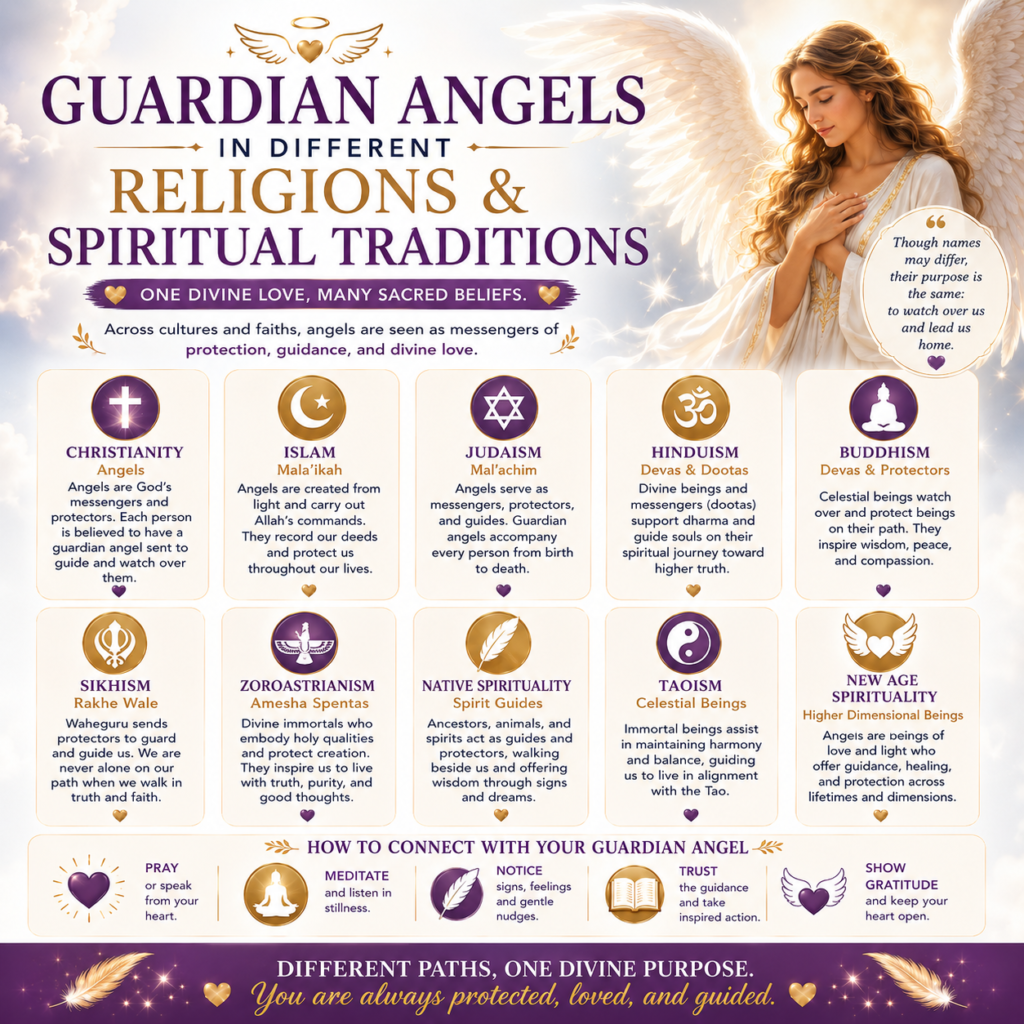
CATEGORY: Archangels
The belief that unseen spiritual beings guide, protect, and encourage humanity is one of the oldest ideas found throughout history. Although the term guardian angel is most commonly associated with Christianity, remarkably similar concepts appear in Judaism, Islam, Zoroastrianism, and many spiritual traditions around the world.
While each faith understands these heavenly helpers differently, a common thread emerges: human beings are not believed to journey through life completely alone. Many traditions teach that divine guidance is available, offering protection, wisdom, comfort, and encouragement throughout life’s challenges.
Understanding how different religions view guardian angels not only broadens our appreciation of world spirituality but also highlights the universal human desire for hope, meaning, and connection with something greater than ourselves.
What Is a Guardian Angel?
A guardian angel is generally understood as a spiritual being entrusted with watching over, protecting, or guiding an individual.
Depending on the tradition, guardian angels may be seen as:
- Messengers of God.
- Protectors.
- Spiritual companions.
- Guides toward righteousness.
- Sources of comfort.
- Helpers during difficult times.
- Witnesses to human actions.
- Symbols of divine care.
Although beliefs differ, guardian angels are almost always associated with goodness, compassion, and service to the Divine.
Guardian Angels in Christianity
Christianity contains one of the most developed traditions concerning guardian angels.
Many Christians believe that God appoints angels to protect and guide individuals throughout their lives.
Several biblical passages are frequently associated with this belief.
For example, Psalm 91 speaks poetically of God’s angels guarding people in all their ways.
Similarly, Matthew 18:10 refers to the angels of little children continually beholding the face of God, a passage many theologians have connected with guardian angels.
The New Testament also contains numerous accounts of angels delivering messages, offering protection, and strengthening believers during important moments.
While Christian denominations differ regarding the exact role of guardian angels, many agree that angels serve God’s will rather than acting independently.
Guardian Angels in Catholic Tradition
The Catholic Church places particular emphasis on guardian angels.
Catholic teaching holds that every person is entrusted to the care of a guardian angel from the beginning of life.
Guardian angels are believed to:
- Protect individuals.
- Inspire good thoughts.
- Encourage virtuous actions.
- Pray for those under their care.
- Help people draw closer to God.
The Catholic calendar even includes the Feast of the Guardian Angels, celebrated annually on October 2.
Many Catholics regularly include prayers asking their guardian angel for protection and guidance.
Guardian Angels in Eastern Orthodox Christianity
Eastern Orthodox Christianity also teaches that angels actively participate in God’s care for humanity.
Guardian angels are viewed as faithful servants of God who help believers remain spiritually focused.
Orthodox prayers frequently acknowledge the presence of guardian angels, asking for wisdom, protection, and strength during life’s struggles.
The emphasis remains on drawing closer to God rather than seeking communication with angels for its own sake.
Angels in Judaism
Judaism has a rich tradition concerning angels, although ideas about personal guardian angels vary among different Jewish communities.
The Hebrew Bible contains many accounts of angels acting as God’s messengers.
Examples include angels who:
- Protect individuals.
- Deliver divine messages.
- Guide travelers.
- Announce important events.
- Carry out God’s commands.
Rabbinic writings sometimes describe angels accompanying righteous individuals or protecting them during times of danger.
However, Jewish teaching consistently emphasizes that worship belongs to God alone rather than to angels.
Angels in Islam
Islam contains a highly developed understanding of angels.
Known as mala’ika, angels are created by Allah to carry out specific divine responsibilities.
Among their many duties are:
- Delivering revelation.
- Recording human deeds.
- Protecting believers according to God’s will.
- Praising Allah continually.
- Carrying out divine commands.
Many Muslims believe that angels accompany every person throughout life.
The Qur’an refers to noble recording angels who document each individual’s words and actions.
Other traditions describe guardian angels protecting people unless Allah wills otherwise.
Like Christianity and Judaism, Islam teaches that angels are entirely obedient to God and possess no independent divine authority.
Zoroastrian Perspectives
One of the world’s oldest monotheistic religions, Zoroastrianism, includes spiritual beings known as Fravashis.
Although not identical to guardian angels, Fravashis are often understood as protective spiritual entities connected with individuals.
They are associated with:
- Moral guidance.
- Protection.
- Spiritual strength.
- Encouragement toward righteousness.
Scholars have suggested that some later angelic traditions may have been influenced by early Persian religious ideas.
Guardian Spirits in Indigenous Traditions
Many Indigenous cultures around the world hold beliefs about protective spiritual beings.
Although these figures are not usually called angels, they often serve similar symbolic roles.
Examples include:
- Spirit guardians.
- Animal protectors.
- Ancestor spirits.
- Nature guardians.
- Divine messengers.
These traditions frequently emphasize harmony between humanity, nature, and the spiritual world.
The exact beliefs differ greatly among cultures and should not be viewed as identical to the angelic traditions of Abrahamic religions.
Angels in Modern Spirituality
Outside organized religion, many people today believe in guardian angels from a broader spiritual perspective.
Rather than focusing on religious doctrine, they often describe guardian angels as loving sources of:
- Encouragement.
- Healing.
- Inspiration.
- Protection.
- Intuition.
- Inner wisdom.
Some individuals believe angels communicate through:
- Repeating numbers.
- Meaningful coincidences.
- Dreams.
- White feathers.
- Intuitive insights.
- Unexpected feelings of peace.
While these interpretations are popular in contemporary spirituality, they are not universally accepted by every religious tradition.
Similarities Across Traditions
Despite important theological differences, many traditions share several common ideas.
Guardian beings are generally believed to:
- Encourage goodness.
- Protect rather than control.
- Respect human freedom.
- Serve the Divine.
- Offer hope.
- Inspire courage.
- Help during hardship.
- Remind people they are not alone.
These shared themes help explain why belief in spiritual protection remains widespread across cultures.
Important Differences
Although similarities exist, significant differences should also be recognized.
For example:
Some traditions teach that every person has one guardian angel.
Others believe multiple angels may assist individuals.
Some emphasize prayer directed only to God.
Others include prayers asking guardian angels for intercession or protection.
Certain spiritual traditions encourage interpreting symbolic signs, while others urge caution about assigning supernatural meaning to everyday events.
Respecting these differences helps promote thoughtful understanding rather than oversimplification.
What Can We Learn from These Beliefs?
Regardless of personal faith, guardian angel traditions encourage qualities that many people value:
- Compassion.
- Humility.
- Courage.
- Integrity.
- Gratitude.
- Hope.
- Responsibility.
- Faithfulness.
Whether understood literally or symbolically, the idea of a loving spiritual protector often inspires people to live more thoughtfully and compassionately.
It reminds us that our actions matter and that kindness has lasting significance.
A Universal Desire for Hope
The remarkable presence of guardian-like beings across many cultures suggests something deeply human: people long to believe that goodness, wisdom, and protection accompany them through life’s uncertainties.
Whether described as guardian angels, heavenly messengers, protective spirits, or symbols of divine care, these beliefs encourage individuals to face challenges with greater confidence and hope.
While different religions explain these spiritual helpers in distinct ways, they consistently point toward compassion, moral responsibility, and trust in something greater than ourselves. By appreciating both the shared themes and the unique teachings of each tradition, we gain a richer understanding of humanity’s enduring search for guidance, protection, and spiritual meaning.
The End,
ZodiacBearing
 Discover More From Our Family of Websites
 ZodiacBearing (Astrology, Tarot, Numerology, Angel Numbers & Spiritual Guidance)
 Velourana (Beauty, Makeup, Hair Care, Skincare & Beauty Tips)
 HavenBearing (Home, Living, Organization, Décor & Everyday Inspiration)
 PawBearing (Pet Care, Dog Breeds, Animal Health, Training & Pet Products)
 PsyCatherine (Notes From the Journal of a Psychologist on Real Life)