CATEGORY: How to Read Tarot
Every tarot card tells a story. While many beginners initially try to memorise individual definitions, experienced readers understand that tarot is much more than a collection of fixed meanings. Each card combines symbolism, emotion, archetypes, colours, numbers, and imagery to communicate a message that can change depending on the question, the surrounding cards, and the circumstances of the reading.
Learning tarot becomes much easier when you understand why the cards represent certain ideas instead of trying to memorise long lists of keywords. Once the symbolism begins to make sense, interpreting readings becomes a natural process rather than an exercise in memory.
This guide explores how tarot card meanings are formed, why they can have multiple interpretations, and how beginners can develop confidence in understanding every card they draw.
Why Tarot Cards Have More Than One Meaning
One of the first surprises for new readers is discovering that a single card rarely has only one interpretation.
Take The Sun, for example.
Most guidebooks associate it with happiness, confidence, success, optimism, and clarity. However, depending on the question, The Sun could also represent honesty, personal freedom, childhood, vitality, or finally seeing the truth about a situation.
Likewise, The Hermit might symbolise peaceful self-reflection in one reading but emotional isolation in another.
The card itself has not changed.
The surrounding context has.
Tarot is similar to language. The same word can carry different meanings depending on the sentence in which it appears. Tarot cards work in much the same way, with neighbouring cards providing context that shapes the overall message.
Understanding Symbolism Instead of Memorising Definitions
The artwork on tarot cards is carefully designed to communicate ideas through symbolism.
A river may represent the flow of emotions.
Mountains often symbolise challenges or long-term goals.
A rising sun can indicate hope or new beginnings.
Flowers may represent growth, innocence, or abundance.
Storm clouds frequently suggest uncertainty or emotional tension.
These symbols are not random decorations. They provide visual clues that help readers understand the deeper message within the card.
Rather than asking, “What does this card always mean?” it is often more useful to ask, “What is this picture trying to communicate?”
The Major Arcana: Life’s Greatest Lessons
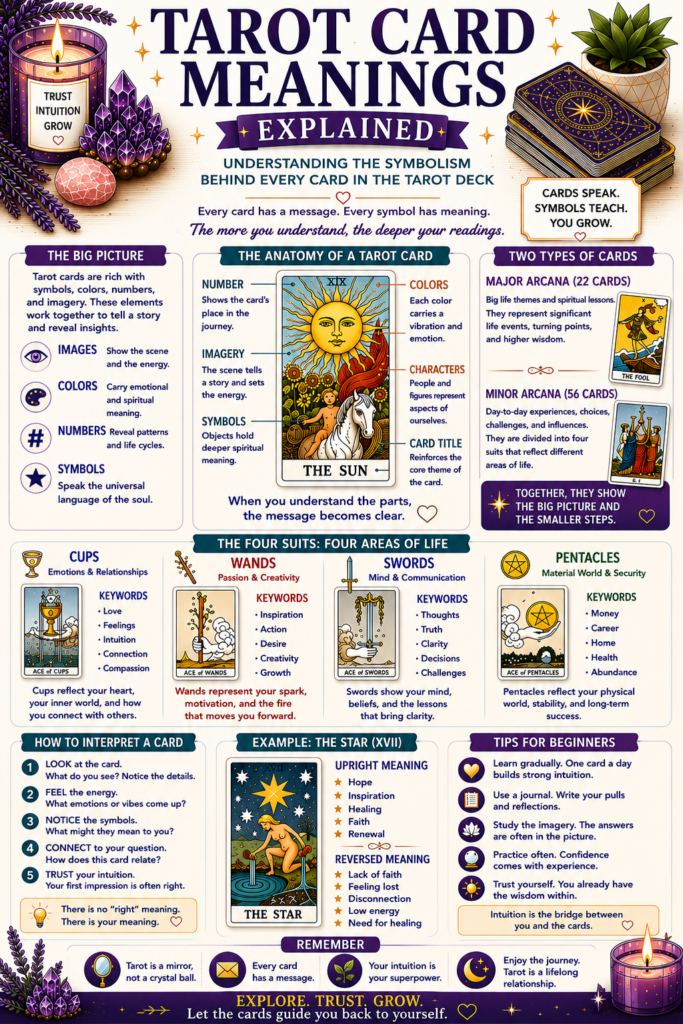
The 22 Major Arcana cards represent the most significant experiences in the human journey.
These cards often appear during periods of personal growth, major decisions, life-changing opportunities, or important emotional transitions.
Some examples include:
The Fool
New beginnings, curiosity, trust, and taking the first step into unfamiliar territory.
The Magician
Confidence, personal power, skill, and using available resources effectively.
The High Priestess
Inner wisdom, intuition, patience, hidden knowledge, and quiet observation.
The Empress
Creativity, nurturing, abundance, beauty, fertility, and emotional growth.
The Emperor
Structure, authority, leadership, discipline, and responsibility.
Each Major Arcana card reflects an important lesson rather than an ordinary daily event, which is why these cards often stand out during a reading.
The Minor Arcana: Everyday Experiences
While the Major Arcana focuses on life’s larger themes, the Minor Arcana reflects daily situations and practical experiences.
These cards often answer questions involving relationships, work, family life, communication, finances, or personal decisions.
Understanding the four suits provides an excellent foundation for interpreting the deck.
Cups
The suit of Cups relates to feelings, emotions, intuition, relationships, compassion, imagination, and the heart.
Water is the symbolic element connected to Cups, reminding readers that emotions are always moving and changing.
Questions involving love, friendship, family, forgiveness, or emotional wellbeing frequently involve this suit.
Wands
Wands represent energy, ambition, creativity, motivation, enthusiasm, and personal growth.
Associated with the element of fire, Wands often appear during periods of inspiration, new projects, travel, education, or career development.
They encourage action rather than hesitation.
Swords
The suit of Swords focuses on the mind.
Thoughts, communication, truth, conflict, decisions, justice, and logic all belong here.
Linked with the element of air, Swords often appear when difficult conversations, important choices, misunderstandings, or intellectual challenges arise.
Although many people fear this suit because several cards appear serious, Swords also represent clarity and honesty.
Pentacles
Pentacles represent the physical world.
Money, work, business, education, health, property, security, and long-term stability all fall within this suit.
Connected with the earth element, Pentacles encourage patience, planning, practical effort, and gradual progress.
They often remind readers that lasting success usually develops over time rather than appearing overnight.
Understanding the Numbers
The numbered cards follow repeating themes across all four suits.
Although each suit has its own subject, the numbers often share similar patterns.
An Ace usually introduces new opportunities.
Twos frequently represent balance or partnership.
Threes often indicate growth or collaboration.
Fours suggest stability or structure.
Fives commonly introduce conflict or change.
Sixes often bring recovery or harmony.
Sevens encourage reflection or testing.
Eights focus on movement or development.
Nines represent nearing completion.
Tens indicate the conclusion of one cycle before another begins.
Recognising these patterns makes learning the deck significantly easier because the same numerical themes appear repeatedly.
The Court Cards
Many beginners find the sixteen Court Cards the most challenging.
Each suit contains:
- Page
- Knight
- Queen
- King
These cards may represent actual people, personality traits, stages of development, or approaches to handling situations.
For example:
Pages often symbolise learning, curiosity, and fresh perspectives.
Knights represent action, movement, determination, or pursuit.
Queens frequently reflect emotional maturity, understanding, and inner confidence.
Kings represent leadership, mastery, experience, and responsibility.
The same Court Card may describe the person asking the question, someone influencing the situation, or an attitude that would be helpful to adopt.
Why Context Always Matters
Imagine drawing the Three of Cups.
During a question about friendships, it may suggest celebration, companionship, or shared happiness.
During a career reading, it could indicate successful teamwork or supportive colleagues.
When asking about creative projects, it may represent collaboration or community encouragement.
The card itself remains unchanged.
Only the context changes.
This flexibility is one of tarot’s greatest strengths.
Combining Card Meanings
A reading rarely depends on one card alone.
Suppose you draw:
The Magician
Eight of Pentacles
The World
Together these cards might suggest using your existing skills, continuing dedicated effort, and eventually achieving success.
Replace The World with the Five of Pentacles, and the overall message changes significantly.
The reading now encourages persistence despite temporary setbacks or financial concerns.
Each additional card modifies the overall story.
Developing Personal Interpretations
Guidebooks provide valuable foundations, but every experienced tarot reader gradually develops personal insights.
Perhaps a particular card consistently appears before major career changes.
Maybe another regularly appears whenever important family discussions arise.
These recurring personal observations become part of your own symbolic vocabulary.
Keeping a tarot journal allows these patterns to emerge naturally over months and years.
Avoiding Common Misunderstandings
Many newcomers become anxious when certain cards appear.
The Death card is probably the best example.
Despite its name, it usually represents endings, transformation, personal growth, or the closing of one chapter before another begins.
Similarly, The Devil often highlights unhealthy attachments, limiting beliefs, or habits rather than literal evil.
The Tower frequently symbolises necessary change, removing unstable foundations so healthier structures can be built.
Understanding symbolism helps prevent unnecessary fear.
Learning Through Observation
One of the most effective study techniques is to spend several minutes simply observing each card.
Notice the colours.
Look at facial expressions.
Ask why certain objects appear.
Consider where the figures are looking.
Observe the weather, landscape, posture, and movement.
Many important meanings become surprisingly clear before opening a guidebook.
This practice strengthens both observation and intuitive understanding.
Building Confidence Over Time
No one learns all seventy-eight cards in a single week.
Confidence develops gradually.
With regular practice, familiar patterns begin to emerge.
You recognise repeating symbols.
You understand how numbers influence each suit.
You notice how neighbouring cards shape one another.
Eventually, the deck feels less like seventy-eight separate cards and more like one complete symbolic system telling a continuous story about human experience.
Final Thoughts
Tarot card meanings are not rigid definitions locked inside individual cards. They are flexible symbols that interact with one another to create thoughtful, meaningful narratives. Understanding the structure of the deck, the symbolism within the artwork, and the repeating patterns found throughout the cards allows readers to move beyond simple memorisation and towards genuine interpretation.
The more time you spend studying the images, reflecting on readings, and recording your experiences, the more natural tarot becomes. Instead of searching for one “correct” meaning, you begin recognising the many ways each card can speak, offering guidance that is both practical and deeply personal.
The End
ZodiacBearing
 Discover More From Our Family of Websites
 ZodiacBearing (Astrology, Tarot, Numerology, Angel Numbers & Spiritual Guidance)
 Velourana (Beauty, Makeup, Hair Care, Skincare & Beauty Tips)
 HavenBearing (Home, Living, Organization, Décor & Everyday Inspiration)
 PawBearing (Pet Care, Dog Breeds, Animal Health, Training & Pet Products)
 PsyCatherine (Notes From the Journal of a Psychologist on Real Life)