CATEGORY: How to Read Tarot
One of the biggest surprises for people learning tarot is discovering that the quality of a reading often has less to do with the cards themselves than with the question asked before the first card is even drawn.
Beginners naturally focus on learning meanings, memorising spreads, and understanding symbolism. Those are all important skills, but they are only part of the process. Even the most experienced tarot reader cannot produce a clear, thoughtful reading from a vague or poorly constructed question.
Imagine asking a friend for advice by saying, “Tell me something.” They would probably not know where to begin. Now imagine saying, “I’m thinking about changing careers, but I’m afraid of making the wrong decision. What would you do?” Suddenly the conversation becomes much clearer because there is context, direction, and a genuine issue to explore.
Tarot works in much the same way.
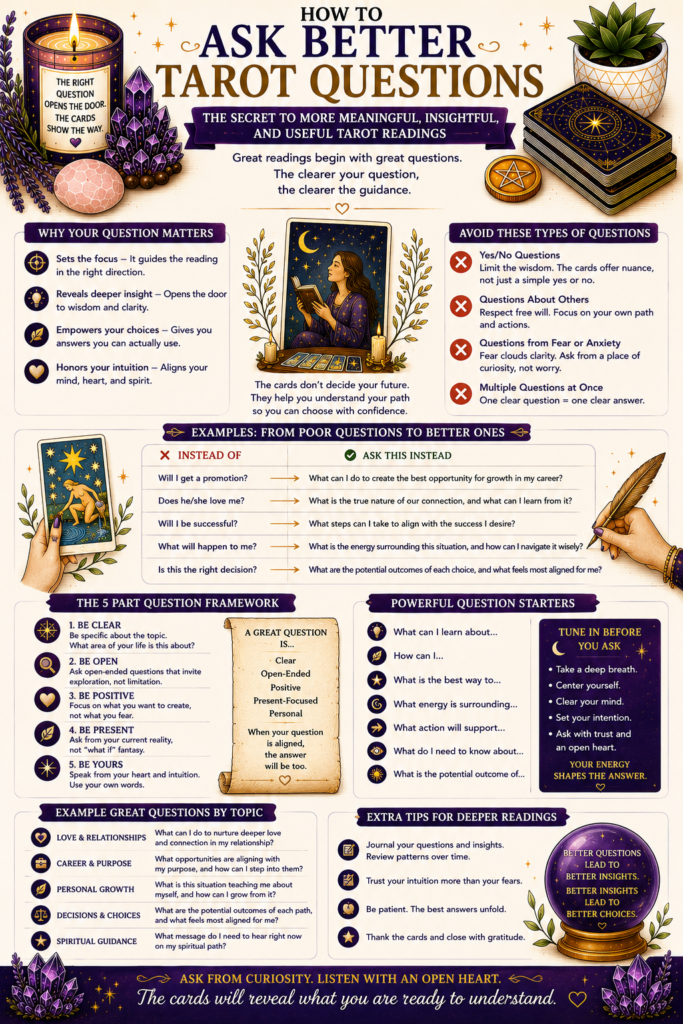
The cards respond best when the question encourages exploration rather than demanding certainty. They are remarkably good at highlighting perspectives, revealing overlooked influences, and encouraging reflection. They are far less useful when treated as a machine designed to produce simple yes-or-no answers about every decision in life.
Learning how to ask better questions is therefore one of the most valuable skills any tarot student can develop. It transforms readings from collections of interesting symbols into practical conversations that genuinely help us think more clearly about the situations we face.
Why the Question Shapes the Entire Reading
Consider two people who draw exactly the same three cards.
The first asks:
“Will I ever be happy?”
The second asks:
“What changes would help me create a happier and more balanced life?”
The cards may be identical, yet the readings are likely to be very different.
The first question is broad, abstract, and almost impossible to define. Happiness means different things to different people, and the cards have very little direction from which to build a meaningful story.
The second question immediately creates focus. Instead of trying to predict an uncertain future, the reading begins exploring actions, attitudes, opportunities, and personal growth. It becomes practical rather than passive.
This illustrates an important principle that experienced readers quickly learn.
Tarot is often most helpful when it encourages understanding rather than prediction.
Moving Beyond Yes-or-No Questions
Perhaps the most common questions asked by beginners are also the least helpful.
“Will I get the job?”
“Will my ex come back?”
“Will I become rich?”
“Will everything work out?”
Although understandable, these questions limit what the cards can offer. They reduce complex situations involving many variables into a request for a single answer.
Life rarely works that way.
A career opportunity may depend upon preparation, timing, competition, and decisions that have not yet been made. Relationships involve two people with independent thoughts and emotions. Financial success depends upon countless choices made over time.
Instead of asking for certainty, try inviting insight.
For example:
“What strengths should I emphasise during this job search?”
“What can I learn from my previous relationship?”
“How can I improve my financial future?”
These questions encourage readings that provide guidance rather than simple predictions.
Questions That Encourage Personal Growth
One of tarot’s greatest strengths lies in helping people understand themselves more deeply.
Rather than focusing entirely on external events, thoughtful questions often explore our own attitudes, habits, fears, and opportunities.
Imagine someone feeling stuck in their career.
A question such as:
“Why am I unsuccessful?”
can easily encourage frustration or self-criticism.
However, changing the wording slightly produces an entirely different reading.
“What abilities have I been overlooking?”
or
“What obstacle is preventing me from moving forward professionally?”
Now the reading becomes constructive.
Instead of dwelling on failure, it begins examining possibilities.
This shift from blame to curiosity often produces far more useful insights.
Allow the Cards Room to Tell a Story
Imagine reading a detective novel after already knowing every detail of the ending.
Much of the excitement would disappear.
Tarot benefits from allowing the cards some freedom to reveal unexpected perspectives.
Suppose someone asks:
“Should I move to another city?”
The cards might unexpectedly focus not on the move itself but on confidence, financial preparation, family responsibilities, or emotional readiness.
If the question had demanded only a yes-or-no answer, those valuable insights might never have emerged.
One of the pleasures of tarot lies precisely in these unexpected observations. The cards frequently highlight aspects of a situation that had not previously been considered.
Avoid Asking the Same Question Repeatedly
It is natural to seek reassurance when facing uncertainty.
Someone waiting to hear about a job interview or an important relationship may feel tempted to ask the same question every day.
Unfortunately, this usually creates confusion rather than clarity.
Different readings may emphasise different aspects of the same situation, leaving the reader uncertain about which interpretation to trust.
Instead, give each reading time to breathe.
Reflect on the guidance offered.
Observe how events unfold.
If circumstances genuinely change, a new reading may provide fresh insight. If nothing has changed, repeatedly asking identical questions often reflects anxiety rather than curiosity.
Tarot encourages thoughtful reflection, not endless reassurance.
Questions About Other People
Another area that deserves careful consideration involves questions focused entirely on someone else’s private thoughts or intentions.
Rather than asking:
“What is my neighbour secretly thinking about me?”
or
“Does my colleague secretly dislike me?”
consider shifting the focus back towards yourself.
For example:
“How can I improve communication with this person?”
or
“What should I understand about this relationship?”
This approach respects personal boundaries while still providing meaningful guidance about the situation.
It also reminds us that the only thoughts and actions we can directly influence are our own.
The Best Questions Usually Begin with “What” or “How”
Although there are many effective ways to phrase a tarot question, beginners often discover that two simple words naturally encourage better readings.
What
and
How.
Questions beginning with these words invite exploration.
“What lesson can I learn from this challenge?”
“What opportunity have I overlooked?”
“How can I improve my confidence?”
“How can I create healthier relationships?”
These questions open the door to richer interpretations because they ask for understanding rather than certainty.
Instead of waiting for life to happen, they encourage active participation in shaping future outcomes.
There Are Times When No Question Is Necessary
Interestingly, not every tarot reading requires a carefully prepared question.
Some readers occasionally shuffle the deck simply asking:
“What do I need to understand today?”
or
“What deserves my attention at this moment?”
These open readings can be surprisingly insightful because they remove expectations and allow the cards to focus on whatever theme appears most relevant.
For beginners, this can also be an excellent exercise in interpretation. Without a narrowly defined topic, you learn to observe how the cards interact naturally and what broader messages emerge from their symbolism.
Remember That Tarot Is a Conversation
Perhaps the most useful way to think about tarot is not as a machine providing fixed answers but as a thoughtful conversation.
A good conversation rarely ends with one-word responses.
Instead, it encourages questions, reflection, and new ways of seeing familiar situations.
The best tarot readings work in exactly the same way.
Rather than telling you what must happen, they encourage you to think more carefully about what could happen, why it matters, and how your own choices may influence the outcome.
Seen from this perspective, every well-phrased question becomes the beginning of a meaningful dialogue rather than a search for certainty.
Final Thoughts
Learning to ask better tarot questions is one of the most important steps towards becoming a confident reader. Well-crafted questions invite thoughtful guidance, reveal hidden influences, and encourage practical reflection, while vague or overly restrictive questions often limit the depth of a reading. By focusing on understanding rather than prediction, you allow the cards to offer richer perspectives that are genuinely useful in everyday life.
The next time you prepare for a reading, spend as much care choosing your question as you do shuffling the deck. A clear, open, and reflective question creates the foundation for meaningful interpretation and often leads to insights that extend far beyond the original issue. In many cases, the quality of the question becomes the first step towards discovering the answer.
The End
ZodiacBearing
 Discover More From Our Family of Websites
 ZodiacBearing (Astrology, Tarot, Numerology, Angel Numbers & Spiritual Guidance)
 Velourana (Beauty, Makeup, Hair Care, Skincare & Beauty Tips)
 HavenBearing (Home, Living, Organization, Décor & Everyday Inspiration)
 PawBearing (Pet Care, Dog Breeds, Animal Health, Training & Pet Products)
 PsyCatherine (Notes From the Journal of a Psychologist on Real Life)