CATEGORY: Guardian Angels
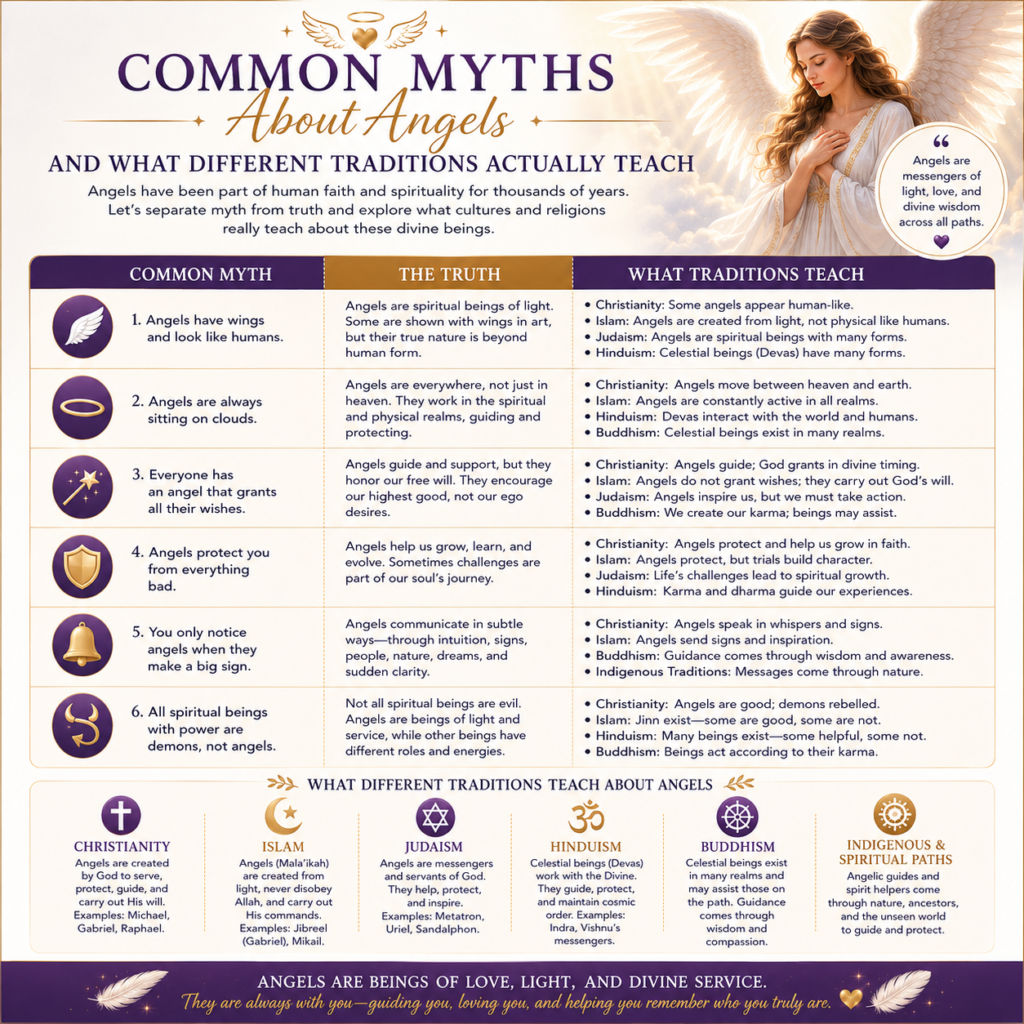
Angels have fascinated humanity for thousands of years. They appear in sacred scriptures, religious art, literature, folklore, and modern popular culture. Because of their widespread presence, many ideas about angels have become deeply rooted in public imagination. However, not all of these beliefs are supported by religious teachings or historical tradition.
Films, television, novels, social media, and personal stories have introduced countless interpretations of angels—some inspiring, others fictional. As a result, it can sometimes be difficult to distinguish between long-standing religious beliefs, modern spiritual ideas, and creative storytelling.
This article explores some of the most common myths about angels while examining what major religious and spiritual traditions actually teach. Understanding these differences encourages a balanced, respectful approach to one of humanity’s oldest spiritual subjects.
Why So Many Myths Exist
Unlike many historical subjects, angels are primarily understood through faith, religious tradition, and spiritual experience.
Because people naturally wonder about the unseen world, many ideas have developed over centuries through:
- Religious interpretation.
- Works of art.
- Literature.
- Folklore.
- Personal testimony.
- Popular entertainment.
- Modern spirituality.
- Cultural traditions.
Some beliefs overlap across traditions, while others are unique to particular faiths or modern interpretations.
Myth 1: Everyone Agrees About Angels
One of the biggest misconceptions is that all religions teach exactly the same things about angels.
In reality, beliefs differ considerably.
For example:
- Christianity teaches that angels are created by God and serve His will.
- Judaism emphasizes angels as God’s messengers while placing worship solely on God.
- Islam teaches that angels (mala’ika) faithfully carry out Allah’s commands and do not disobey Him.
- Some spiritual traditions focus more on symbolic guidance than formal doctrine.
Although similarities exist, each tradition has its own understanding of the role and nature of angels.
Myth 2: Angels Always Have Wings
When most people imagine an angel, they picture a beautiful human figure with large white wings.
This image has become familiar largely through centuries of religious art.
However, many sacred texts describe angels in a variety of ways.
Some biblical accounts describe angels appearing simply as ordinary people.
Others contain symbolic visions involving extraordinary heavenly beings with multiple wings or other striking features.
Because artistic representations developed over time, wings became a visual symbol of heavenly origin rather than a universal physical description.
Myth 3: Angels Grant Every Wish
Many people imagine angels as magical beings who immediately solve every problem.
Most religious traditions do not teach this.
Instead, angels are generally understood to:
- Offer guidance.
- Protect according to God’s will.
- Deliver messages.
- Encourage faith.
- Strengthen courage.
Life’s challenges, personal responsibility, and free will remain important parts of spiritual growth.
Rather than removing every difficulty, angelic guidance is often believed to help people face those difficulties with greater strength.
Myth 4: Every Coincidence Is an Angel Sign
Modern discussions frequently suggest that every repeated number, feather, or coincidence must be an angelic message.
Most experienced spiritual teachers recommend greater discernment.
Meaningful experiences certainly deserve reflection.
However, ordinary events also occur naturally.
Healthy spirituality allows room for both faith and common sense.
Many traditions encourage asking:
- Does this inspire kindness?
- Does it bring peace?
- Does it encourage wisdom?
- Does it align with moral values?
These questions help avoid assigning supernatural meaning to every ordinary occurrence.
Myth 5: Angels Should Be Worshipped
Major Abrahamic religions consistently teach that worship belongs to God alone.
Angels are understood as servants or messengers rather than objects of worship.
In Christianity, Judaism, and Islam, angels point believers toward God rather than toward themselves.
Respect for angels does not replace devotion to the Divine.
This distinction remains one of the clearest shared teachings across these faiths.
Myth 6: Only Special People Can Experience Angels
Some people believe only saints, prophets, or mystics can receive angelic guidance.
Many religious traditions teach otherwise.
While extraordinary experiences are considered rare, divine care is generally understood to be available to everyone.
Many believers find comfort in the idea that spiritual encouragement is not limited by age, education, social status, or personal background.
Myth 7: Angels Predict the Future
Popular culture often portrays angels as revealing detailed future events.
Religious teachings tend to present a different emphasis.
When angels appear in sacred texts, their messages usually encourage:
- Faith.
- Obedience.
- Hope.
- Courage.
- Repentance.
- Protection.
- Perseverance.
Rather than satisfying curiosity about the future, these messages often focus on how people should live in the present.
Myth 8: Every Dream About an Angel Has One Meaning
Dream interpretation has always been highly personal.
Even within religious traditions, symbols often depend on context.
A peaceful dream involving light may inspire hope for one person.
Another individual may simply be processing recent experiences emotionally.
Most thoughtful approaches recommend considering:
- Personal circumstances.
- Emotional impact.
- Spiritual growth.
- Long-term meaning.
Avoid assuming that every dream carries a universal interpretation.
Myth 9: Angels Replace Personal Responsibility
Some people hope spiritual guidance will make every decision for them.
Most traditions teach the opposite.
Human beings are encouraged to develop:
- Wisdom.
- Discernment.
- Compassion.
- Responsibility.
- Patience.
- Integrity.
Guidance is often understood as support rather than substitution.
Thoughtful decision-making remains an essential part of life.
Myth 10: We Can Know Everything About Angels
Perhaps the greatest misconception is believing that humanity possesses complete knowledge about angels.
Across religious history, angels remain mysterious.
Sacred texts provide important teachings while leaving many questions unanswered.
Different traditions interpret those teachings differently.
Recognizing these limits encourages humility.
Accepting that some mysteries remain unresolved allows faith and curiosity to coexist without demanding certainty where certainty may not be possible.
What Most Traditions Have in Common
Despite theological differences, many beliefs about angels share several important themes.
Angels are generally associated with:
- Goodness.
- Protection.
- Service to the Divine.
- Guidance.
- Hope.
- Compassion.
- Faithfulness.
- Encouragement.
These shared values explain why belief in angels continues to inspire millions of people around the world.
Why Discernment Matters
Whether you approach angels through religion, spirituality, or personal reflection, discernment is essential.
Healthy discernment involves:
- Remaining open without becoming gullible.
- Respecting different beliefs.
- Avoiding fear-based interpretations.
- Considering practical explanations.
- Reflecting on whether an experience promotes love, wisdom, and responsibility.
This balanced perspective helps keep spiritual exploration both meaningful and grounded.
Finding Inspiration Without Losing Perspective
Angels have inspired artists, writers, theologians, and believers for centuries because they symbolize hope, protection, and the possibility that goodness accompanies humanity even during difficult times. While myths and popular culture have added many imaginative ideas to the conversation, the enduring message found across numerous traditions remains remarkably consistent: live with compassion, seek wisdom, trust in the Divine according to your beliefs, and treat others with kindness.
Rather than becoming preoccupied with sensational stories or searching for extraordinary signs everywhere, focus on the qualities that angel traditions consistently encourage—humility, courage, gratitude, patience, and love. Whether you understand angels as literal heavenly messengers or powerful spiritual symbols, these timeless values continue to offer guidance that can enrich everyday life and deepen our appreciation for the mystery and beauty of the human journey.
The End,
ZodiacBearing
 Discover More From Our Family of Websites
 ZodiacBearing (Astrology, Tarot, Numerology, Angel Numbers & Spiritual Guidance)
 Velourana (Beauty, Makeup, Hair Care, Skincare & Beauty Tips)
 HavenBearing (Home, Living, Organization, Décor & Everyday Inspiration)
 PawBearing (Pet Care, Dog Breeds, Animal Health, Training & Pet Products)
 PsyCatherine (Notes From the Journal of a Psychologist on Real Life)