CATEGORY: How to Read Tarot
Every experienced tarot reader has one thing in common.
At some point, they were beginners who made mistakes.
Some misunderstood the cards completely. Others relied too heavily on guidebooks. Many became frustrated because their readings seemed confusing or contradictory. A surprising number even considered giving up after convincing themselves that they simply “weren’t good at tarot.”
If that sounds familiar, there is good news.
Making mistakes is not a sign that you are failing—it is one of the most valuable parts of learning tarot. Like learning a new language or playing a musical instrument, tarot develops through experience. The first readings rarely feel natural because your brain is trying to process symbolism, card meanings, spreads, intuition, and the question itself all at once.
The encouraging reality is that almost every beginner struggles with the same obstacles. Once you recognise these common mistakes, they become much easier to overcome. Instead of slowing your progress, they can actually become stepping stones towards becoming a more confident and thoughtful reader.
Expecting to Memorise All Seventy-Eight Cards Immediately
One of the first traps beginners fall into is believing they must memorise every meaning before they can perform a reading.
They buy books, print keyword lists, highlight important passages, and spend hours trying to remember hundreds of definitions.
After a few days they realise something frustrating.
The more they try to memorise, the more the meanings seem to blur together.
This happens because tarot is not designed to be learned like a dictionary. The cards form a symbolic language. Languages are not mastered by memorising isolated words; they become familiar through repeated use, context, and experience.
Think about learning to drive a car. During your first lesson you consciously think about every movement—mirrors, pedals, steering, gears, speed, traffic, and signs. Months later those same actions happen almost automatically because experience has replaced conscious effort.
Tarot develops in much the same way.
The goal is not to memorise seventy-eight separate cards as quickly as possible. The goal is to become familiar with the patterns that connect them. Once you understand the personalities of the four suits, the journey of the Major Arcana, and the themes carried by the numbers, individual meanings begin falling into place naturally.
Reading Too Many Cards at Once
Enthusiasm often leads beginners towards large and complicated tarot spreads.
After all, if three cards can provide insight, surely ten or fifteen cards must provide even better answers.
In reality, the opposite often happens.
Imagine asking three close friends for advice on an important decision. Their opinions may already give you plenty to consider. Now imagine asking fifty people. Instead of becoming clearer, the situation is likely to become confusing.
Large tarot spreads create the same problem.
Every additional card introduces another layer of interpretation. For someone still learning the basics, this quickly becomes overwhelming.
A simple three-card spread often teaches far more than an elaborate Celtic Cross because it encourages careful observation rather than information overload.
Many professional readers continue using small spreads throughout their careers because clarity is usually more valuable than complexity.
Treating the Guidebook as the Only Authority
Guidebooks are excellent teachers.
They explain symbolism, historical traditions, and widely accepted interpretations that provide an essential foundation for beginners.
Problems arise only when readers begin believing the guidebook is the only possible source of meaning.
Imagine drawing the Five of Cups.
The guidebook may describe disappointment, regret, or emotional loss.
Yet while looking at the artwork, you notice something the book barely mentions. The figure is standing beside two upright cups that remain untouched. Although attention is fixed on what has been lost, something valuable has survived.
That observation is not contradicting the guidebook.
It is expanding upon it.
Experienced readers constantly move between traditional meanings and their own careful observations. They understand that the artwork often contains details that become particularly important in the context of a specific reading.
Learning tarot therefore involves studying established interpretations while remaining curious about what the images themselves are communicating.
Becoming Afraid of Certain Cards
Few moments cause more anxiety for beginners than turning over cards like Death, The Tower, or The Devil.
Popular culture has given these cards dramatic reputations, encouraging the belief that they predict disaster.
Fortunately, tarot symbolism is rarely so literal.
The Death card often appears when someone changes careers, leaves an unhealthy relationship, or finally lets go of habits that no longer serve them. Something ends, but that ending creates room for something healthier to begin.
The Tower usually represents sudden change rather than unavoidable catastrophe. Sometimes life removes unstable foundations because they were preventing future growth.
The Devil frequently explores limitation. It asks honest questions about habits, fears, unhealthy attachments, or beliefs that quietly restrict personal freedom.
Once beginners understand this symbolic approach, fear begins giving way to curiosity. Instead of asking, “What terrible thing will happen?” they begin asking, “What transformation is taking place?”
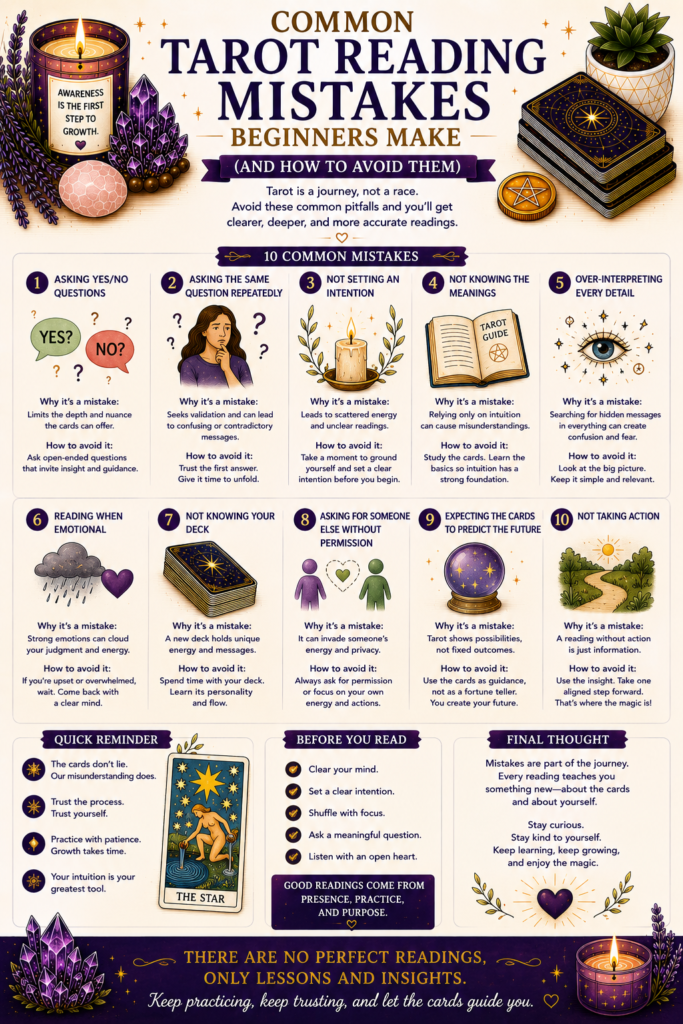
Asking the Same Question Again and Again
Waiting can be uncomfortable.
Whether it is a job interview, a relationship, a medical appointment, or an important decision, uncertainty naturally creates anxiety.
Some beginners respond by repeatedly asking the tarot exactly the same question.
One reading becomes three.
Three become ten.
Eventually the answers seem to contradict one another, creating even greater confusion than before.
This usually happens because the reader is no longer seeking understanding—they are searching for reassurance.
Tarot works best when given room to breathe.
After completing a thoughtful reading, spend time reflecting upon it. Observe how events develop in real life before returning to the same subject. If circumstances genuinely change, another reading may reveal something new. If nothing has changed, constant repetition rarely produces additional clarity.
Ignoring the Story the Cards Are Telling
Perhaps the most subtle mistake beginners make is treating every card as though it exists in isolation.
Imagine reading a novel one page at a time but refusing to consider how each chapter connects with the next.
The story would make little sense.
Tarot functions through relationships.
A hopeful card beside a challenging one may suggest optimism despite temporary obstacles.
A practical Pentacle between two emotional Cups might indicate that financial concerns are influencing a relationship.
A reading is not simply a collection of separate definitions. It is a conversation taking place between symbols.
Learning to recognise those conversations is often the moment when tarot begins feeling truly natural.
Expecting Immediate Mastery
Modern life encourages quick results.
We expect tutorials to teach new skills in minutes and online courses to provide instant expertise.
Tarot does not work that way.
The cards gradually become familiar through repetition, reflection, and experience. Meanings deepen over months and years because they become connected with real situations you have personally encountered.
Every reading teaches something new.
Sometimes it teaches about the cards.
Sometimes it teaches about yourself.
Sometimes it teaches patience.
The readers who improve the most are rarely those who learn fastest. They are usually the ones who remain curious long enough for experience to replace uncertainty.
Final Thoughts
Every beginner makes mistakes while learning tarot, and that is exactly how meaningful progress happens. The goal is not to avoid every misunderstanding but to recognise them, learn from them, and continue practising with patience. Each reading develops observation, confidence, and a deeper appreciation for the symbolic language of the cards.
Rather than striving for perfection, focus on steady improvement. Give yourself permission to learn gradually, trust that experience will strengthen your understanding, and remember that even the most knowledgeable tarot readers continue discovering new insights within the same seventy-eight cards. Tarot is a lifelong journey, and every mistake simply becomes another lesson along the way.
The End
ZodiacBearing
 Discover More From Our Family of Websites
 ZodiacBearing (Astrology, Tarot, Numerology, Angel Numbers & Spiritual Guidance)
 Velourana (Beauty, Makeup, Hair Care, Skincare & Beauty Tips)
 HavenBearing (Home, Living, Organization, Décor & Everyday Inspiration)
 PawBearing (Pet Care, Dog Breeds, Animal Health, Training & Pet Products)
 PsyCatherine (Notes From the Journal of a Psychologist on Real Life)