CATEGORY: How to Read Tarot
If you ask ten beginner tarot readers what they find most difficult, many will give the same answer.
It is not remembering the cards.
It is not learning the spreads.
It is not even understanding the symbolism.
It is trusting themselves.
Almost every newcomer experiences the same quiet doubt after laying out the cards. They recognise the images, remember a few meanings, perhaps even notice interesting patterns, yet a question lingers in the back of their mind.
“What if I’m completely wrong?”
This uncertainty is perfectly normal. In fact, it is almost unavoidable. Tarot asks us to interpret symbols rather than solve mathematical equations. There is rarely one single sentence that can be labelled as the correct answer. Instead, a reading develops through observation, reasoning, and gradually recognising how individual cards combine to tell a coherent story.
Confidence therefore does not arrive suddenly one morning. It grows in much the same way as confidence in any other skill. A musician becomes more confident after playing hundreds of songs. A photographer develops confidence after taking thousands of photographs. A chef gains confidence by preparing countless meals.
Tarot is no different.
The readers who appear naturally confident today are almost always the ones who spent years asking themselves exactly the same questions beginners ask now.
Confidence Is Built Through Understanding, Not Blind Faith
One of the biggest misconceptions surrounding tarot is the belief that experienced readers simply “know” what every card means the moment it appears.
The reality is usually far less mysterious.
An experienced reader notices details that a beginner may overlook.
They recognise that several cards belong to the same suit.
They observe repeating numbers.
They notice whether the figures are moving towards one another or turning away.
They recognise when a card changes the emotional tone of the entire spread.
None of these observations require supernatural abilities. They are skills developed through careful study and repeated practice.
Imagine visiting an art gallery with an experienced art historian. At first glance, you both see the same painting. Yet the historian notices influences, techniques, historical references, and artistic decisions that remain invisible to someone seeing the artwork for the first time.
Tarot develops in much the same way.
The more familiar you become with the language of the cards, the more naturally your interpretations begin to flow.
Stop Looking for the “Perfect” Meaning
Many beginners pause after drawing a card because they are searching for one precise definition.
They remember reading that the card symbolises confidence.
Then another book says it represents ambition.
A third source mentions leadership.
Suddenly they worry about choosing the wrong interpretation.
In reality, all three meanings may be valid.
The important question is not which meaning exists in isolation.
The important question is which meaning makes the most sense within the reading itself.
Suppose someone asks about starting a new business and draws The Magician.
Confidence, initiative, personal ability, and making practical use of existing skills all fit naturally within that situation.
Now imagine the same card appearing in a reading about personal relationships.
Its emphasis may shift towards communication, honesty, influence, or recognising one’s own strengths.
The card has not changed.
Only the conversation surrounding it has.
Understanding this simple principle removes much of the pressure beginners place upon themselves.
Learn to Read the Whole Story
Think about reading a novel.
No one judges the plot after reading a single paragraph.
Each chapter provides additional information until the complete story becomes clear.
Tarot spreads work exactly the same way.
A challenging card does not automatically indicate failure.
A joyful card does not guarantee success.
Every card gains meaning through its relationship with the others.
Imagine drawing The Tower, The Star, and The Sun together.
Looking only at The Tower might create unnecessary concern.
However, viewed as a sequence, the cards tell a far richer story.
Something unexpected creates disruption.
Hope gradually returns.
Clarity and confidence eventually follow.
The reading becomes a narrative of recovery rather than disaster.
When beginners begin reading stories instead of isolated definitions, confidence usually increases dramatically.
Trust Observation Before Intuition
People often speak about intuition as though it were an invisible gift that only certain individuals possess.
This idea discourages many beginners before they have even begun.
Fortunately, what many readers call intuition often starts with something much simpler—careful observation.
Look closely at the artwork.
Is the figure standing confidently or cautiously?
Are they looking towards the future or the past?
Does the scene appear peaceful or chaotic?
Which colours dominate the image?
What object immediately catches your attention?
These observations create a logical foundation for interpretation.
Only after noticing these visual details does intuition begin adding personal insight.
In other words, intuition usually grows from observation rather than replacing it.
Accept That Every Reading Will Teach You Something
One reason experienced readers continue improving for decades is that they treat every reading as a learning opportunity.
Sometimes a card surprises them.
Sometimes real-life events unfold differently than expected.
Occasionally they discover a symbolic detail they had overlooked for years.
Instead of viewing these moments as failures, they see them as valuable lessons.
This attitude is incredibly important for beginners.
If every reading must be perfect, learning quickly becomes stressful.
If every reading is allowed to become a lesson, improvement becomes almost inevitable.
Avoid Comparing Yourself with Experienced Readers
Modern technology makes it possible to watch professional tarot readers from around the world.
While this offers wonderful learning opportunities, it can also create unrealistic expectations.
A reader with twenty years of experience naturally appears more confident than someone who bought their first deck last month.
That comparison is neither fair nor helpful.
Imagine expecting yourself to play the piano as well as a concert pianist after only a few weeks of practice.
Tarot deserves the same patience.
Focus on becoming a slightly better reader than you were yesterday rather than comparing yourself with someone who has spent years developing their skills.
Progress measured against your own experience is usually far more encouraging.
Keep a Tarot Journal and Review It
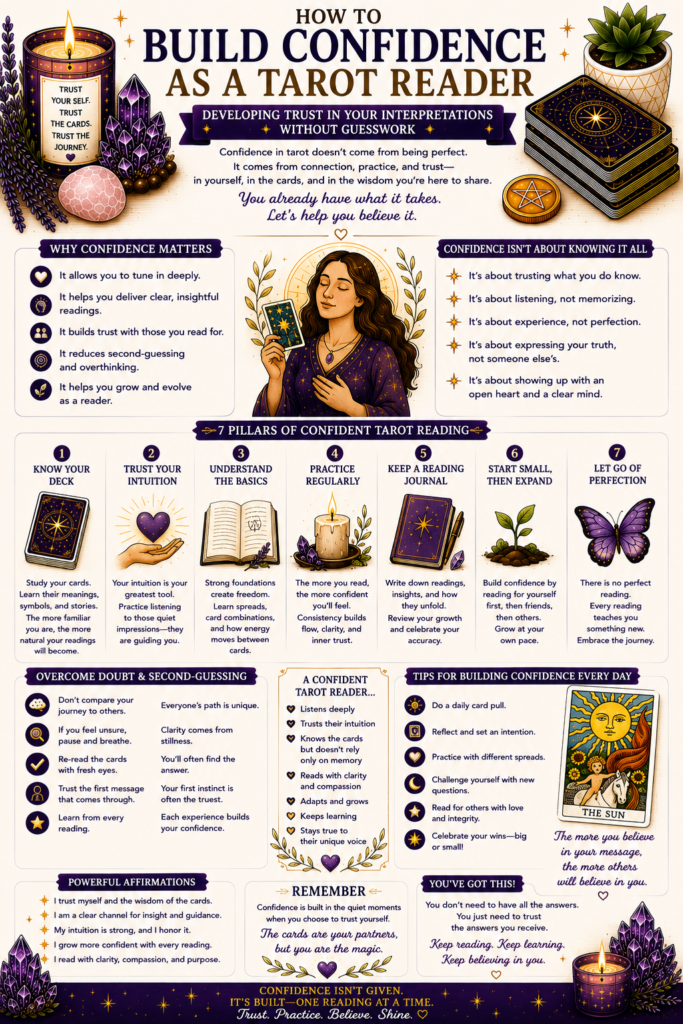
One of the simplest ways to build confidence is by recording your readings.
Write down:
- The question.
- The cards drawn.
- Your interpretation.
- What eventually happened.
Weeks or months later, return to those notes.
You may discover that your interpretations were more accurate than you initially believed.
You may also notice recurring themes connected with particular cards.
Perhaps The Hermit repeatedly appears before periods of important personal reflection.
Perhaps The Eight of Pentacles often accompanies career development.
These personal observations gradually strengthen your confidence because they arise from your own experience rather than someone else’s guidebook.
Remember That Tarot Is a Skill, Not a Test
Many beginners unknowingly approach tarot as though every reading has a hidden correct answer waiting to be discovered.
This creates unnecessary pressure.
Tarot is not an examination.
It is a conversation.
Like any meaningful conversation, different people may notice different aspects while still reaching valuable conclusions.
The purpose is not to produce identical interpretations every time.
The purpose is to develop thoughtful, honest, and well-reasoned insights that genuinely help explore the question being asked.
Once this perspective replaces the fear of being “wrong,” confidence begins growing naturally.
Final Thoughts
Confidence in tarot does not appear overnight, nor does it depend upon possessing extraordinary intuition or memorising hundreds of card meanings. It develops through regular practice, thoughtful observation, and the willingness to learn from every reading. Every spread becomes another opportunity to recognise patterns, deepen your understanding of symbolism, and discover how the cards communicate together.
Perhaps the most reassuring truth for every beginner is that uncertainty never completely disappears—and it does not need to. Even highly experienced readers continue approaching the cards with curiosity and respect rather than absolute certainty. Confidence is not believing you will always be correct; it is trusting that, with patience and practice, you will continue growing into a more thoughtful and capable reader every time you pick up the deck.
The End
ZodiacBearing
 Discover More From Our Family of Websites
 ZodiacBearing (Astrology, Tarot, Numerology, Angel Numbers & Spiritual Guidance)
 Velourana (Beauty, Makeup, Hair Care, Skincare & Beauty Tips)
 HavenBearing (Home, Living, Organization, Décor & Everyday Inspiration)
 PawBearing (Pet Care, Dog Breeds, Animal Health, Training & Pet Products)
 PsyCatherine (Notes From the Journal of a Psychologist on Real Life)