CATEGORY: How to Read Tarot
Every person who begins learning tarot quickly discovers that the cards themselves are only part of the journey. Long before most beginners feel confident enough to perform their first reading, they usually have dozens of practical questions.
Can I read tarot for myself?
Do I need special abilities?
Should I memorise every card before beginning?
Can I use a digital deck?
What happens if I draw the same card repeatedly?
Many of these questions have circulated for generations. Others have become more common as tarot has grown in popularity through books, websites, social media, and online communities. The reassuring news is that most of these concerns are shared by almost everyone who starts learning.
This collection of frequently asked questions brings together clear, balanced answers to help new readers understand the practice with greater confidence. Rather than focusing on myths or dramatic claims, the goal is to explain what most experienced readers have learned through years of working with the cards and to provide practical guidance for building your own understanding.
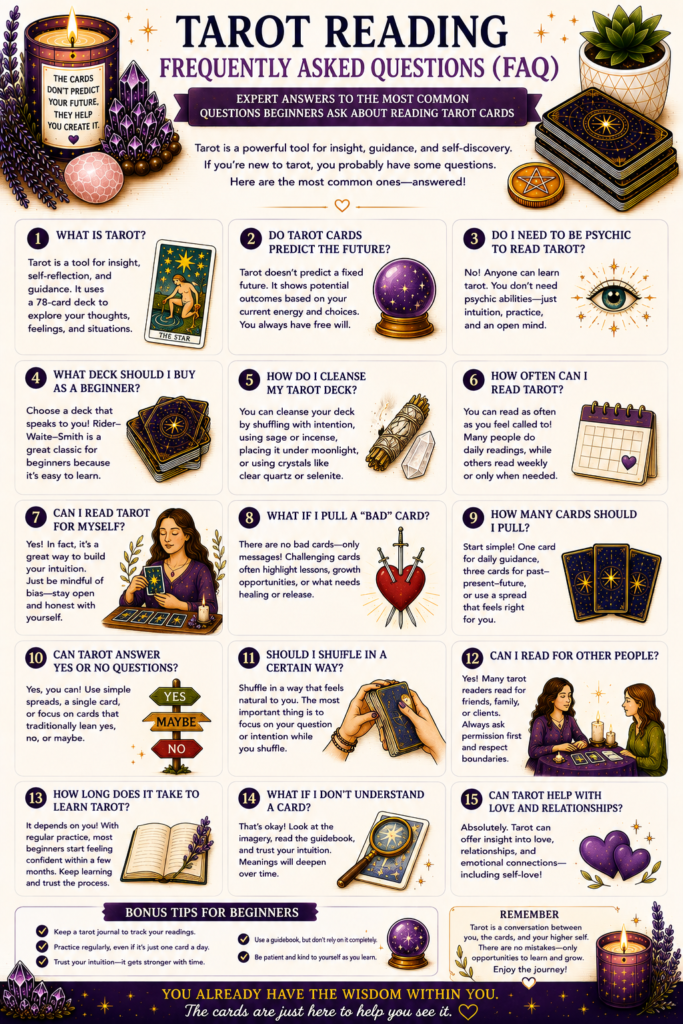
Do I Need Psychic Abilities to Read Tarot?
No.
Perhaps the most widespread misunderstanding about tarot is the belief that only psychics can read the cards accurately.
In reality, tarot is primarily a symbolic system. It combines visual storytelling, traditional meanings, observation, intuition, and thoughtful interpretation.
Some readers describe intuitive experiences during readings, while others approach tarot as a reflective tool similar to journaling or meditation. Neither perspective prevents someone from learning.
If you can carefully observe images, think about symbolism, and remain open to different perspectives, you already possess the most important qualities needed to begin.
Can I Read Tarot for Myself?
Yes.
In fact, many people first discover tarot through personal readings.
Reading for yourself can be an excellent way to become familiar with the cards because you already understand the background of the situations you are exploring.
However, self-readings also require honesty.
Because emotions naturally influence interpretation, it can sometimes be tempting to notice only the meanings we hope to see. This is one reason many readers keep a tarot journal. Recording interpretations before events unfold encourages greater objectivity when reviewing the reading later.
Which Tarot Deck Should a Beginner Buy?
There is no single correct answer.
Choose a deck whose artwork encourages you to spend time studying the cards.
Many teachers recommend the Rider–Waite–Smith system because most educational resources explain its symbolism in detail. This makes learning easier during the early stages.
However, the most important consideration is whether you genuinely enjoy looking at the illustrations. A deck that inspires curiosity is far more likely to become part of your regular practice than one chosen only because someone else recommended it.
Should I Memorise Every Card Before Doing My First Reading?
Definitely not.
Waiting until all seventy-eight cards have been memorised usually delays learning unnecessarily.
Tarot is best understood through experience.
Begin with simple one-card or three-card readings. Use a guidebook when needed, observe the artwork carefully, and allow familiarity to develop naturally over time.
Most experienced readers continue consulting books even after many years because tarot is a lifelong study rather than a subject that is ever completely finished.
What If I Forget a Card’s Meaning?
This happens to everyone.
Even highly experienced readers occasionally pause to reflect on a card or revisit reference material.
Instead of worrying about remembering every keyword immediately, begin by studying the illustration.
Notice the expressions, colours, movement, symbols, and overall atmosphere.
Very often these visual clues provide valuable insight before you even open a guidebook.
Over time, repeated exposure makes the meanings increasingly familiar.
Can I Read Tarot Every Day?
Yes, provided the practice remains thoughtful rather than compulsive.
Many readers enjoy drawing a single card each morning as a prompt for reflection throughout the day.
Others complete longer readings only when important questions arise.
The important consideration is not frequency but purpose.
Using tarot to encourage self-awareness and careful reflection is generally more productive than repeatedly asking the same question in search of reassurance.
Why Do the Same Cards Keep Appearing?
Repeated cards often attract attention because they seem unusually meaningful.
There are several possible explanations.
From a practical perspective, frequently used decks naturally produce recurring patterns over time.
From a symbolic perspective, many readers view repeating cards as invitations to pay closer attention to particular themes or lessons that remain relevant.
Regardless of personal beliefs, recurring cards are often worth exploring through journaling and thoughtful reflection rather than assuming they carry mysterious significance.
What Does It Mean If I Draw a “Bad” Card?
The idea of a permanently “bad” tarot card is largely a misconception.
Cards such as Death, The Devil, or The Tower have dramatic names and imagery, yet their symbolic meanings are usually far more constructive than many beginners expect.
Death commonly represents transformation, endings, and renewal.
The Devil often highlights unhealthy habits or limiting beliefs.
The Tower frequently symbolises sudden change that ultimately clears the way for healthier foundations.
Rather than predicting unavoidable misfortune, these cards usually encourage growth through change.
Can Tarot Predict the Future?
People hold many different beliefs about this question.
Some readers believe tarot can indicate likely future possibilities based on present circumstances.
Others see the cards primarily as tools for self-reflection, helping people examine choices, attitudes, opportunities, and challenges.
Regardless of personal perspective, most experienced readers agree on one important point.
Human decisions matter.
The future is shaped not only by circumstances but also by the choices people continue making every day.
Tarot is therefore often most valuable when used to improve understanding rather than seeking absolute certainty.
Should I Cleanse or Charge My Tarot Deck?
Many books and online discussions describe rituals involving crystals, moonlight, incense, or meditation.
These practices are entirely personal.
Some readers enjoy them because they create a sense of mindfulness before a reading.
Others simply shuffle the cards and begin.
Neither approach is universally correct.
The value lies in whether the practice helps you focus, not in following a rule that everyone must accept.
Can I Use Online or Digital Tarot Apps?
Yes.
Digital tarot applications and websites can provide useful opportunities for study, particularly when travelling or learning card meanings.
However, many readers continue preferring physical decks because handling the cards encourages slower observation and creates a more tactile, reflective experience.
Ultimately, the quality of interpretation depends far more on thoughtful reading than on whether the cards are made of paper or displayed on a screen.
How Long Does It Take to Become Good at Tarot?
There is no fixed timeline.
Some people feel comfortable performing simple readings within a few weeks.
Developing deeper understanding usually takes much longer because tarot is built upon symbolism, personal experience, observation, and continuous learning.
The encouraging aspect of tarot is that improvement rarely stops. Even readers with decades of experience often discover fresh interpretations or notice symbolic details they had previously overlooked.
Learning tarot is therefore less like completing a course and more like gradually becoming fluent in a new language.
Final Thoughts
Every tarot reader begins with questions, uncertainties, and moments of self-doubt. That is not a weakness—it is a natural part of learning any meaningful skill. The more time you spend studying the cards, reflecting on your readings, and remaining curious about their symbolism, the more these early questions gradually transform into confidence and understanding.
Perhaps the most valuable lesson for beginners is that tarot does not demand perfection. It rewards patience, thoughtful observation, and a genuine willingness to keep learning. Whether you approach the cards as a spiritual practice, a tool for personal reflection, or simply an enjoyable symbolic tradition, the journey is one of continual discovery. Every shuffle, every reading, and every question becomes another opportunity to understand both the cards and yourself a little more deeply.
The End
ZodiacBearing
 Discover More From Our Family of Websites
 ZodiacBearing (Astrology, Tarot, Numerology, Angel Numbers & Spiritual Guidance)
 Velourana (Beauty, Makeup, Hair Care, Skincare & Beauty Tips)
 HavenBearing (Home, Living, Organization, Décor & Everyday Inspiration)
 PawBearing (Pet Care, Dog Breeds, Animal Health, Training & Pet Products)
 PsyCatherine (Notes From the Journal of a Psychologist on Real Life)